
Groove and Return
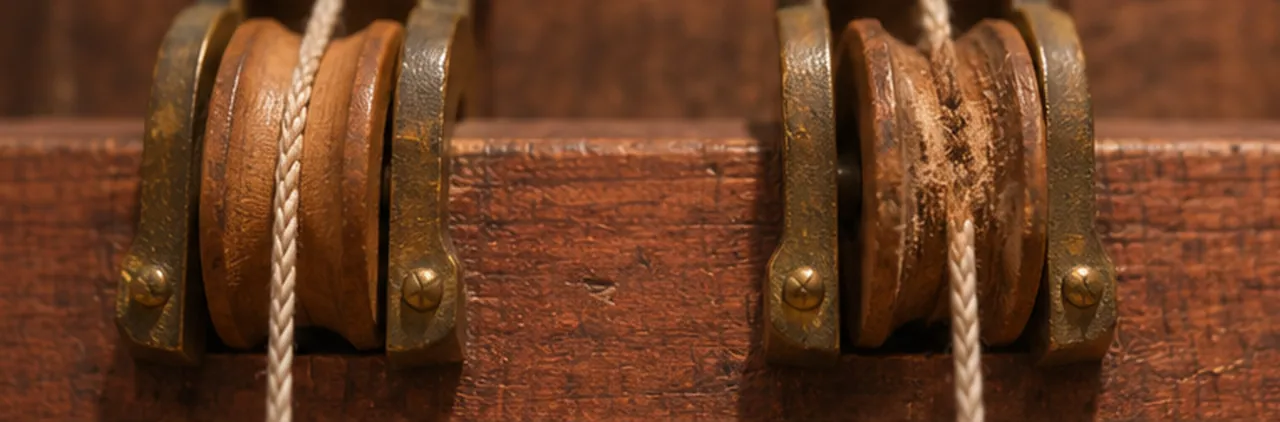
We started by taking the actor off the stage, leaving only a cord and a shallow wooden wheel above a bare board. The cord carried a small weight. One side had an ordinary worn groove; the other was stained along the edge so we could see movement where it traveled past the lip. We wanted to know whether someone watching a short rehearsal could distinguish the end of slack from the start of a lift. The thin line around the wheel gives a repeatable way to look for that instant. It also keeps the sight of the actor from answering the question too early.
Read the part above the weight
Lift the free end until the hanging section takes on a long shallow curve. Draw it a little farther. Now the bend moves toward the weight while the cord near the rim straightens. If the camera shows both ends, there is a clear order to the events. The loose part of the line leaves the lip before the weight visibly rises. This gives the viewer something to follow while the movement is preparing. Without a view of the cord, the stage can look frozen throughout the first part of the pull.
A mark at the head of the groove helped establish which part of the cord was moving. At first we covered most of the lip with paint. The large patch looked like a control conspicuously placed for the player. A small scrape of pale wood just beside the run was enough to place the curve. We made another test with little light from the front. The line lost several of its lighter strands but there was still an edge next to the scrape. It showed the turn happening at the top of the wheel before the weight moved at the bottom of the view.
Keep the reset readable
Let the wheel return a little before putting the weight down. The curve comes back while the weight is still close to its last position. At that speed the changing part of the cord can look like a tiny flick across the lip. Some people read the flick as an order to lift again. We opened the time between these two events and showed a little more of the wood behind the cord. You can see the longer arc appear without mistaking it for the change that follows. The second pass at full speed preserves enough of that view to show which end has begun a new action.
The cord is thicker near the point where it bends under load. One side of the groove has a groove line with a round edge. The other has wear on the flatter surface next to it. Both give a hand-built cue for a stage that uses the wheel in more than one direction. If the actor pulls from farther downstage, the line comes into the groove obliquely. We keep the visible contact short, then compare whether the extra angle makes the signal harder to follow from the wing. The test covers a small part of the whole movement, which makes it easier to isolate a misleading shadow.
Bring the actor back
The Footlight Crossing uses the wheel when the actor has reached the first board but the rear shoe is still close to the near side of the trap. The line above that rear shoe may return slowly as the lead foot takes weight. Tension at the Riser shows the place where the shoe first approaches a hard edge. From there, a player can look momentarily upward to read the cord and return to the deck just as the foot lifts. The next sample will compare an actor seen at eye level with the same pause from above the stage. We want both views to show the relationship between the returning line and the new pose.